7 Best Power Rakes for Dethatching a Lawn (November 2026)
The best power rakes for dethatching a lawn include the BlumeTrec Thatch Rake for most yards, the Greenworks 13 Amp 14-Inch Corded Dethatcher for powered work on medium lawns, and the MaxPower 330100B Power Rake Blade for fitting an existing mower.
On this page (5 sections)
The best power rake for dethatching a lawn in most yards is the BlumeTrec 74-inch thatch rake, because its 15-inch dual-sided head pulls dead material out of the turf and its long stainless handle saves your back. Pick the Greenworks 13 Amp when you want a motor to do the combing on a medium lawn.
Thatch is the layer of dead stems and roots that settles between the grass blades and the soil. When it gets thick, water and air stop reaching the roots.
A power rake for dethatching a lawn fixes that by combing the layer out rather than just tidying the surface.
This roundup covers seven tools in three groups: manual thatch rakes, corded machines and one tow-behind unit. The right one depends on your lawn size, your tolerance for physical work and whether you already own a mower you can tow behind.
If you only need the basics of raking by hand, our guide to how to use a dethatching rake covers the stroke and timing.
Our picks at a glance
-
1
-
2
 Best for powered work on medium lawns
Greenworks 13 Amp 14-Inch Corded Dethatcher
9.6/10 our score
See it on Amazon -
3
 Best for fitting an existing mower
MaxPower 330100B Power Rake Blade
9.2/10 our score
See it on Amazon
- 4
 Check it
TaskStar Dethatcher and Scarifier
Best for collecting debris as you go - 5
 Best for tall usersCheck it
- 6
 Best for shared householdsCheck it
- 7
 Check it
YITAMOTOR 40-Inch Tow Behind Rake
Best for large properties
The best power rakes for dethatching, by yard and job
The BlumeTrec rake is the best overall for a typical suburban lawn, while the other six picks each solve a specific situation. Read the write-ups for the machine that matches your yard size and how much effort you want to spend.
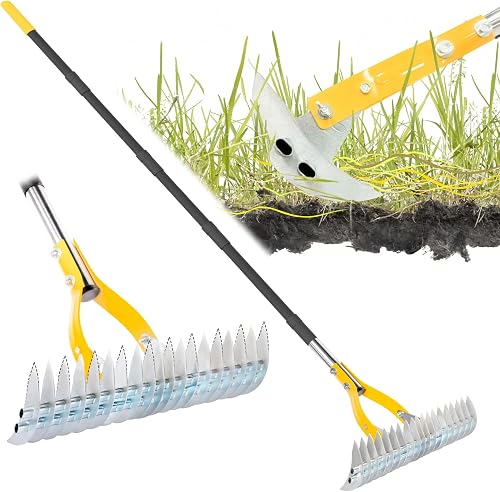
BlumeTrec Thatch Rake: Best for most yards
- 74-inch maximum handle
- 15-inch dual-sided head with 19 tines
- Manganese steel head
- Adjustable handle length
A long stainless handle and a dual-sided 19-tine head make this the simplest first tool for lifting thatch and loosening surface soil.
Pros
- 74-inch reach reduces bending
- Two tine sides for dethatching and soil loosening
- Handle sections come apart for storage
Cons
- Manual effort does the work
- Needs assembly before first use
BlumeTrec suits the homeowner with an average lawn who wants to dethatch without buying a motorized machine. Its 15-inch head carries 19 curved tines, and the head flips between a dethatching side and a cultivation side for loosening soil.
The manganese steel head is quenched for hardness and powder coated to resist rust. The handle runs up to 74 inches in sections, so you can set the length for your height and take it apart for shed storage.
A cushioned grip helps when the raking gets long.
The tine angle matters more than most buyers expect. Shallow positioning works for light surface combing, while a deeper setting digs under the mat for thorough thatch removal during regular maintenance.
That flexibility is what lets one tool cover spring cleanup and fall leaf raking without buying a separate leaf rake.
Assembly takes minutes with the included tools. The trade-off is effort: this is a manual tool, so a large lawn will take several passes and some stamina.
Against the corded machines here, it wins on simplicity and reach but loses on speed. The whole unit weighs 2.1 kg, so it's easy to carry between beds and up steps.
It's the pick for most people because it does the core job with no cord, no outlet and no engine to maintain. Pick a powered unit instead when your lawn runs past about a quarter acre.
Greenworks 13 Amp 14-Inch Corded Dethatcher: Best for powered work on medium lawns
- 13-amp motor at 3,200 RPM
- 14-inch working path
- Two attachments in one tool
- 3-position depth adjustment
A corded dethatcher and scarifier in one body, with a push-button start and three depth settings for seasonal cleanup.
Pros
- Switch between dethatcher and scarifier
- Push-button start
- Depth adjusts in three steps
Cons
- Cord limits how far you roam
- Heavier than a hand rake
Greenworks suits a medium lawn where hand raking would take too long. The 13-amp motor spins at 3,200 RPM across a 14-inch path, and a push button starts it without a pull cord.
Two attachments ship in the box: a dethatching reel for pulling thatch and a scarifier reel for cutting into the surface. A 3-position depth adjustment lets you set how aggressively the tines bite.
The whole unit weighs 28.7 pounds, so it rolls along without much pushing.
Greenworks gives seasonal guidance too: early spring or early fall for cool-season grass, late spring to early summer for warm-season turf. The cord is the real limit, since you'll trail an extension cord and work within its reach.
It's also the simpler of the two corded machines in this roundup.
Against the TaskStar, this model has a narrower path and no collection bag. It wins on being the simpler powered option for a first-time dethatcher.
Greenworks also backs it with a 3-year warranty, which is longer than the 1-year cover on the TaskStar.
MaxPower 330100B Power Rake Blade: Best for fitting an existing mower
- 16-inch blade
- 1-inch center hole
- Six reducing washers included
- Made in the USA
A replacement power rake blade that turns a suitable walk-behind mower into a dethatching tool without a second machine.
Pros
- Uses a mower you already own
- Reducing washers fit several shaft sizes
- Cover washer included
Cons
- Fits only mowers that accept this blade type
- No engine or frame of its own
MaxPower suits someone who already owns a walk-behind mower that accepts a power rake blade. This 16-inch blade with a 1-inch center hole mounts in place of the mower blade and combs the lawn as you push.
The kit includes a cover washer and six reducing washers in sizes from 3/16 inch to 5/8 inch, which widens the range of shafts it can fit. It's made in the USA and MaxPower says it meets or exceeds OEM specs.
This is the cheapest way into powered dethatching if your mower is compatible, since there's no second engine or frame to store. The catch is fit: you need to confirm your mower takes this blade type before buying, and there's no bag or depth control.
One more practical point: the blade only works as well as the mower pushing it. A weak or tired walk-behind will struggle in thick thatch, where a dedicated 13 or 15-amp motor keeps its speed.
The blade itself weighs just 1.6 pounds, so it adds little load to the machine.
Against the standalone corded machines here, it saves money and garage space but gives up adjustability. Choose it only when your mower is the right host.
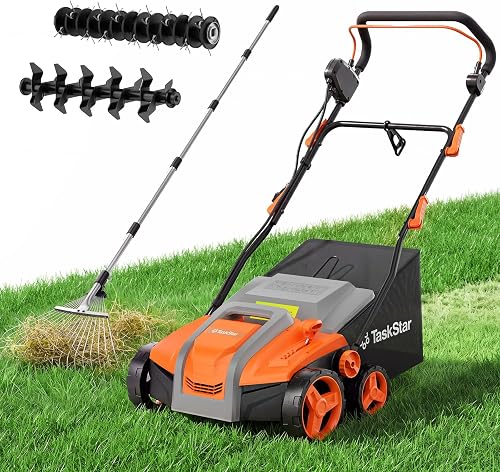
TaskStar Dethatcher and Scarifier: Best for collecting debris as you go
- 15-amp motor at 3,500 RPM
- 16-inch path
- 5-position depth adjustment
- 14.5-gallon collection bag
A two-in-one corded machine with a collection bag and a bonus hand rake for edges the 16-inch head cannot reach.
Pros
- Bag catches loosened thatch
- Bonus thatch rake for corners
- Overload protection built in
Cons
- Bag fills fast on heavy thatch
- Folding handle still needs storage room
TaskStar suits a lawn where you want the debris collected as you go. The 15-amp motor reaches 3,500 RPM across a 16-inch path, as wide as the MaxPower blade's cut, and the 14.5-gallon bag catches what the tines lift.
A 5-position depth dial ranges from -1/2 inch to +1/4 inch. The kit also includes a separate thatch rake that adjusts from 55 to 83.5 inches for edges and tight corners the machine can't reach.
Overload protection cuts the motor if it bogs down.
At 28 pounds with a folding handlebar, it stores more compactly than its size suggests. The bag is the trade-off: TaskStar says it fills fast in heavy thatch and recommends removing it for large areas.
Budget for a thick outdoor extension cord, since the 15-amp draw needs 14 AWG up to 25 feet and 12 AWG beyond 50 feet.
The depth dial needs a note on setup. TaskStar advises keeping grass at about 1.97 inches and mowing taller turf before you start, so the tines work evenly instead of snagging.
The 3-position handlebar also adjusts to different user heights, which helps when more than one person shares the job.
It's the pick when you want one machine plus a hand tool for the whole job. TaskStar rates it for lawns up to half an acre.
Lilyvane Thatch Rake: Best for tall users
- 55-inch total length
- 19 tines on a 14.5-inch head
- Stainless steel build
- Adjustable head angle
A stainless rake with dual central support bars and a head you can angle for light combing or deep thatch work.
Pros
- Reinforced head-to-handle connection
- Angle adjusts for push or pull strokes
- Breaks down for small storage
Cons
- Shorter reach than the top pick
- Manual effort only
Lilyvane suits taller users who want a long reach without stepping up to a machine. The rake runs 55 inches overall with a 14.5-inch head and 19 stainless steel tines.
Two central support bars connect the head to the handle, and two screws anchor the head to those bars to limit wobble during hard pulls. The head angle adjusts so you can comb lightly on the surface or dig in for deep thatch.
The two sides of the head work differently. The scarifier side has slightly flat parts on the bottom and a flat top for breaking compacted soil and leveling ground.
The dethatcher side curves up with no flat parts, so it pulls up thick layers of thatch, moss and dead grass. That split makes it useful on gravel paths and garden beds as well as turf.
All-stainless construction resists rust and warping across seasons. It breaks into shorter sections for storage in a small shed or garage, and setup takes about 3 minutes with the included tools.
The head is slightly narrower than the BlumeTrec's, and the reach is shorter, so very tall users may prefer the 74-inch option.
Choose it for a medium lawn and a shed with little room. It's the manual rake to beat for build strength.
Walensee 15-Inch Thatch Rake: Best for shared households
- Three handle lengths
- 15-inch dual-sided head
- 19 curved manganese steel tines
- Cushioned grip
A manual dethatcher that adjusts to three handle lengths so different people in the house can use it comfortably.
Pros
- Three handle settings
- Dual-sided head for thatch and soil
- Detachable for storage
Cons
- Manual dethatching takes real effort
- Handle sections need checking during long sessions
Walensee suits a household where more than one person dethatches. The sectional stainless handle sets to roughly 40, 55 or 70 inches, so a shorter and a taller user can each find a comfortable grip.
The 15-inch head has 19 curved manganese steel tines with a dual-sided design: one side lifts dead grass, the other loosens topsoil. The head is quenched and powder coated to resist rust and wear.
A cushioned non-slip grip helps on long sessions.
The twist-lock handle sections need a check before and during use, which Walensee notes in its instructions. Manual dethatching is physical work, so plan to do it in manageable sections rather than one marathon pass.
The 4.6-pound weight is light enough to swing all afternoon but still feels solid in the head.
The three lengths cover more ground than a fixed handle. Set it short for close work around beds and long for open lawn so you stand straighter.
A separate leaf rake is not needed, since the same head gathers fallen leaves and light debris between dethatching sessions.
Against the BlumeTrec, this rake costs less reach at the top end but more flexibility for shared use. Pick it when the rake has to fit two different people.
YITAMOTOR 40-Inch Tow Behind Rake: Best for large properties
- 40-inch working width
- 20 spring steel tines
- 70-lb weighted tray
- Lift handle for transport
A tow-behind rake that covers a wide strip behind a riding mower or ATV and needs no cord or engine of its own.
Pros
- 40-inch path covers ground fast
- Lift handle switches to transport mode
- Universal hitch fits most riders and ATVs
Cons
- Needs a tow vehicle
- Weighted tray needs 70 lb of ballast for deep work
YITAMOTOR suits a large property where a riding mower or ATV is already in the shed. Its 40-inch width covers more ground per pass than any hand tool or corded unit here, and 20 heat-treated spring tines pull thatch, dead grass and moss as you drive.
A reinforced steel frame carries a tray that holds up to 70 pounds for deeper ground engagement. The lift handle raises the tines for transport or hard surfaces.
Rubber-treated wheels follow lawn contours, and a universal hitch attaches to most riding mowers and ATVs.
The tines also do light shallow aeration as they comb, which opens the surface so water and nutrients reach the roots. Because the unit is towed, there's no motor to maintain and no cord to drag.
The 40-inch path and the triple-loop tines are built to be replaceable, so a worn set can be swapped rather than replacing the whole rake.
The trade-offs are real: you need a tow vehicle, and the tray needs ballast loaded before the tines bite deep. It also gives you less control over depth than the dial-equipped machines.
At 34.2 pounds empty, it's light to hitch but needs the weight to work.
Choose it only for large, open lawns. On a small city lot, a hand rake does the job with less hassle.
How these power rakes compare
Every pick here removes thatch, but they split cleanly by power source and lawn size. Manual rakes suit small to medium lawns and tight storage.
Corded machines trade cord reach for speed. The tow-behind unit trades maneuverability for width.
| Product | Best for | Head width | Maximum length | Power source | Our score |
|---|---|---|---|---|---|
| BlumeTrec Thatch Rake | most yards | 15 in | 74 in | Manual | 9.7 |
| Greenworks 13 Amp 14-Inch Corded Dethatcher | powered work on medium lawns | Corded electric | 9.6 | ||
| MaxPower 330100B Power Rake Blade | fitting an existing mower | Mower-driven | 9.2 | ||
| TaskStar Dethatcher and Scarifier | collecting debris as you go | Corded electric | 8.8 | ||
| Lilyvane Thatch Rake | tall users | 14.5 in | Manual | 8.7 | |
| Walensee 15-Inch Thatch Rake | shared households | 15 in | Manual | 8.0 | |
| YITAMOTOR 40-Inch Tow Behind Rake | large properties | Towed | 6.8 |
Our score weighs specs, features and buyer feedback against what you're shopping for. The manual rakes score high because they do the core job with fewer failure points and less setup.
The tow-behind unit sits lower because it needs a second machine and ballast to work well.
If you're still weighing a hand tool against a machine, our explainer on power rake vs dethatcher sorts out what each name actually means.
How we compared these power rakes
We compared the seven tools on head width, tine count, handle reach, depth settings and what each one needs to run. We also checked which jobs each tool can do beyond plain dethatching, such as scarifying or soil loosening.
Lawn size was the first filter. A 14-inch corded path and a 40-inch tow-behind path cover very different yards, and a manual rake's reach matters more on a slope than on flat ground.
A wide head saves passes, but it also makes tight corners and beds harder to reach without a second tool.
We weighed build materials too. Manganese and stainless steel heads hold up to repeated seasonal use, while a blade that mounts on an existing mower only makes sense when that mower is compatible.
Powder coating and quenched steel are the details that separate a rake that lasts several seasons from one that bends in thick thatch.
Then we looked at cleanup. A collection bag saves raking afterward, and a bonus hand rake helps with edges.
Those extras change the real time a job takes, not just the purchase. A bag also means less bending to gather piles, which matters on larger lawns.
Finally, we considered storage and setup. Detachable handles and folding bars decide whether a tool fits a small shed, and assembly time decides whether you'll actually pull it out for a quick pass.
A tool that's hard to store tends to stay stored.
What should you check before buying a power rake for dethatching?
Check three things first: your lawn size, whether you have an outdoor outlet near the turf and how much physical work you want to do. Those answers narrow the field faster than any spec sheet.
How much lawn do you need to dethatch?
Lawn size decides whether a manual rake is enough. A quarter acre or less is comfortable with a hand rake in one or two sessions.
Above that, a corded or towed machine starts saving real time.
TaskStar's estimates give a useful benchmark for corded work: 20 to 30 minutes for 500 to 1,000 sq ft and 1 to 1.5 hours for 2,000 to 5,000 sq ft. A manual rake will run longer than that on the same ground.
On a 2,000 sq ft lawn, expect the hand tool to take a couple of relaxed afternoons rather than a single morning.
Do you have an outlet within cord reach?
A corded dethatcher needs an outdoor outlet and an extension cord rated for the motor's draw. The Greenworks runs on 13 amps and the TaskStar on 15 amps, so a light indoor cord won't do.
TaskStar's cord guidance is worth following on any corded machine: 14 AWG up to 25 feet, 14 AWG or better to 50 feet and 12 AWG beyond that. A wrong cord is a common cause of motor failure.
Plan the outlet as part of your buying decision, not an afterthought.
Would a blade for your mower be cheaper than a machine?
If your walk-behind mower takes a power rake blade, the MaxPower 330100B is the least expensive route to powered dethatching. You avoid a second engine, a second storage spot and a second cord.
Confirm the blade type and center hole fit before you buy. A blade that doesn't match your mower is money wasted, and there's no depth control or bag with this approach.
Measure your mower's shaft and compare it with the 1-inch center hole and the six reducing washers in the kit.
What else should you have on hand?
Dethatching makes a mess. A bag catches some of it, but plan for raking or blowing the rest into piles.
A tarp helps move the thatch to a compost pile without scattering it back across the lawn.
Mow first and water lightly a day or two before if the ground is hard. The tines bite better in slightly soft soil.
Our guide on how to power rake a lawn walks through the pass order and cleanup. Gloves are worth wearing, since the curved tines are sharp on both manual and powered heads.
When is a cordless dethatcher the better buy?
A cordless dethatcher suits lawns where cords are a nuisance, such as front yards without an outlet or beds split by paths. It trades runtime for freedom of movement.
Our roundup of the best cordless dethatchers covers models built for home lawns.
For most yards up to a quarter acre, a corded machine or a manual rake still gives more consistent power for the money. Cordless makes sense when the cord is the thing stopping you from doing the job.
The verdict: which power rake should you buy?
Buy the BlumeTrec 74-inch thatch rake for most lawns. It needs no cord or engine, its dual-sided head handles thatch and soil, and the long handle keeps the work comfortable.
It's the best power rake for dethatching a lawn when simplicity matters more than speed.
Step up to the Greenworks 13 Amp for a medium lawn where you want a motor to do the combing. Choose the TaskStar when collecting debris as you go matters.
Pick the MaxPower blade only if your mower takes it, and go tow-behind with the YITAMOTOR only on a large property with a rider.
Whichever you choose, dethatch when the grass is actively growing so it can recover. That timing rule matters more than any feature difference between these tools.
Our top 3 picks at a glance
-
1
-
2
Best for powered work on medium lawns
Greenworks 13 Amp 14-Inch Corded Dethatcher
9.6/10 our score
See it on Amazon -
3
Best for fitting an existing mower
MaxPower 330100B Power Rake Blade
9.2/10 our score
See it on Amazon
Frequently asked questions
What does a power rake do that a leaf rake cannot?
A power rake pulls dead thatch out of the turf rather than lifting leaves off the top. Its tines reach under the grass blades, and powered models spin them to comb the lawn faster.
A leaf rake is built for surface debris and will not clear a packed thatch layer.
When should you dethatch a lawn?
Greenworks says to dethatch in early spring or early fall for cool-season grasses. For warm-season grasses, the window runs from late spring through early summer, after the second mowing.
The grass should be actively growing so it can recover from the raking.
Do you need a collection bag when dethatching?
A bag helps on small lawns and light thatch. TaskStar says the bag fills quickly during real dethatching work and suggests removing it for large areas.
Without a bag you rake or blow the loosened material into piles afterward.
Can a tow-behind rake work with a regular push mower?
No. A tow-behind rake needs a riding mower or ATV to pull it, and YITAMOTOR's hitch is built for those machines.
For a push mower, use a hand rake or a corded dethatcher instead.
How much lawn can a corded dethatcher handle in one session?
TaskStar estimates 30 to 45 minutes for 1,000 to 2,000 sq ft and 1 to 1.5 hours for 2,000 to 5,000 sq ft. Cord reach and outlets limit a single pass, so plan your route around the nearest power supply.


