10 Best Gas Rototillers for Home Gardens (November 2026)
The best gas rototillers for home gardens include the Earthquake Versa 99cc Gas Tiller for changing garden jobs, the Tazz 35310 79cc Front-Tine Tiller for seedbeds and garden rows, and the SENIX 4QL 46cc Gas Tiller for compact storage.
On this page (6 sections)
The Earthquake Versa 99cc Gas Tiller is the best rototiller for many home gardens because it combines adjustable 11–21 in width with up to 11 in depth. For a smaller footprint, consider the Echo TC-210; for shallower cultivation, look at either VEVOR model.
A gas tiller helps when you need to loosen more soil than you want to work by hand. The right choice depends on whether you need to open a bed, refresh prepared ground or cultivate between established rows.
If you're still deciding what style fits, our garden tiller guide explains how tine layout, engine power and working width affect the choice. For large gardens, compare these picks with our best rear-tine tillers, and see front-tine vs rear-tine tillers for a layout comparison.
Our picks at a glance
-
1

-
2
 Best for seedbeds and garden rows
Tazz 35310 79cc Front-Tine Tiller
8.5/10 our score
See it on Amazon -
3

- 4
 Best for narrow bedsCheck it
- 5
 Best for separate fuel and oilCheck it
- 6
 Check it
Earthquake Versa 79cc Gas Tiller
Best for adjustable narrow rows - 7
 Check it
VEVOR 43cc 2-Stroke Gas Tiller
Best for light surface cultivation - 8
 Check it
BILT HARD 24-Inch 99cc Gas Tiller
Best for broader garden passes - 9
 Best for wider adjustable coverageCheck it
- 10
 Check it
VEVOR 31cc 4-Stroke Gas Tiller
Best for lighter garden tasks
How we chose these gas rototillers
The best gas rototiller for a home garden should match the garden's size, soil task and storage space. We compared engine type, stated working width and depth, adjustment features and transport details against those needs.
We prioritized models with clear dimensions and useful controls for home beds and rows. A wider path can save passes in open ground, while adjustable tines and handles can make one machine useful for more than one garden task.
The score reflects how well each model's documented features fit common home-garden jobs. It isn't a measure of how long a machine will last or how it will perform in every soil type.
A large engine or broad cutting path is not automatically a better fit. Narrow beds may call for a compact cultivator, while open ground makes adjustable width more useful.
Gas rototiller specs compared
These gas tillers range from 9 in to 24 in in stated width, while maximum stated depth runs from about 4 in to 11 in. Use the table to narrow the field, then compare the product sections for each model's best use and limitations.
| Product | Best for | Engine | Width | Depth | Our score |
|---|---|---|---|---|---|
| Earthquake Versa 99cc Gas Tiller | changing garden jobs | 99cc 4-cycle | 11–21 in | Up to 11 in | 8.9 |
| Tazz 35310 79cc Front-Tine Tiller | seedbeds and garden rows | 79cc 4-cycle | 11, 16 or 21 in | Up to 11 in | 8.5 |
| SENIX 4QL 46cc Gas Tiller | compact storage | 46cc 4-cycle | 15 in | 8 in | 8.0 |
| Echo TC-210 Gas Tiller | narrow beds | 21.2cc | 9 in | 7.9 | |
| BILT HARD 46cc Gas Tiller | separate fuel and oil | 46cc 4-cycle | 16 in | Up to 7.84 in | 7.8 |
| Earthquake Versa 79cc Gas Tiller | adjustable narrow rows | 79cc 4-cycle | 11, 16 or 21 in | Up to 11 in | 7.7 |
| VEVOR 43cc 2-Stroke Gas Tiller | light surface cultivation | 43cc 2-stroke | 11.8 in | 3.9 in | 7.5 |
| BILT HARD 24-Inch 99cc Gas Tiller | broader garden passes | 99cc 4-cycle | 17 in stated working width | At least 3.94 in | 7.4 |
| SPLENDOR 79cc Gas Tiller | wider adjustable coverage | 79cc 4-cycle | 10, 15 or 24 in | Up to 9 in | 7.3 |
| VEVOR 31cc 4-Stroke Gas Tiller | lighter garden tasks | 31cc 4-stroke | 13.38 in | 3.93 in | 7.2 |
The best gas rototillers for home gardens
The Earthquake Versa 99cc is the most flexible choice here, while the other models suit narrower beds, adjustable rows, storage limits or shallow cultivation. Choose by the job you expect to do most often.
Earthquake Versa 99cc Gas Tiller: Best for changing garden jobs
- 99cc 4-cycle Viper engine
- 11–21 in adjustable tilling width
- Up to 11 in tilling depth
- Cultivator and tiller in one
Removable outer tines and side shields let you switch between a wider tilling setup and narrower cultivating widths. Its adjustable handlebar and onboard wheels add useful flexibility for a home garden.
Pros
- Adjustable 11–21 in width
- Tiller and cultivator functions
- Onboard transport wheels
Cons
- 78 lb weight may take effort to move
The Earthquake Versa 99cc suits gardens that need both bed preparation and row maintenance. Its removable outer tines and side shields change the working width from 21 in down to 16 or 11 in.
The 99cc 4-cycle Viper engine powers a front-tine tiller that also works as a cultivator. The handlebar height adjusts, and onboard wheels help move the 78 lb machine between storage and the garden.
Choose it if you need one machine for open beds and narrower rows. Skip it if you mainly tend very small beds and want a light, narrow cultivator; the 9 in Echo is more compact.
Tazz 35310 79cc Front-Tine Tiller: Best for seedbeds and garden rows
- 79cc 4-cycle Viper engine
- 11, 16 or 21 in working widths
- Up to 11 in depth
- Four handlebar height positions
This 2-in-1 front-tine model changes from a 21 in tilling width to narrower cultivating settings. Its four handlebar height positions suit buyers who want more control over setup.
Pros
- Three working widths
- Adjustable handlebar
- Removable outer tines and side shields
Cons
- The 79cc engine is smaller than the top pick's
The Tazz 35310 suits gardeners who want one machine for seedbeds and row care. Its 11, 16 and 21 in widths cover three working sizes.
The 79cc 4-cycle Viper engine drives forged steel tines through a gear drive transmission. Tazz provides four handlebar height positions, and a multi-position drag stake controls depth up to 11 in.
The tiller converts to a cultivator by removing the outer tines and side shields without tools. Choose it if you value multiple working widths and handle adjustment; skip it if you need the larger engine in this roundup's top pick.
SENIX 4QL 46cc Gas Tiller: Best for compact storage
- 46cc 4-cycle engine
- 15 in width
- 8 in depth
- Foldable handles
The SENIX offers a narrower 15 in working width and foldable handles for compact storage. Its 4QL design needs no gas and oil mixing.
Pros
- Foldable handles
- No gas and oil mixing
- Auto choke and compression release
Cons
- Less width and depth than the larger tillers
The SENIX 4QL suits gardeners who want a mid-width machine with foldable handles. Its 15 in working width and 8 in depth fit modest plots where storage space also matters.
The 46cc 4-cycle engine uses SENIX's 4QL technology, which requires no mixing of gas and oil. SENIX says the design supports all-directional use and helps prevent stalling or oil leakage.
An auto choke and compression release support starting, while the handles fold for storage. Choose it for compact storage and no-mix fueling; skip it if you need deeper work or a wide path through open ground.
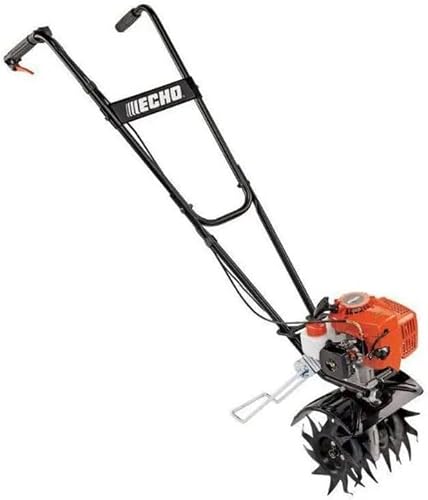
Echo TC-210 Gas Tiller: Best for narrow beds
- 21.2cc engine
- 9 in width
- Front-tine design
The Echo is a small front-tine cultivator with a 9 in working width. Its compact format fits narrow beds better than broad ground preparation.
Pros
- Narrow 9 in width
- 27 lb weight
Cons
- Few published feature details for comparison
The Echo TC-210 is a compact option for narrow beds and small cultivation areas. Its 9 in width is the narrowest stated working path in this roundup, and it weighs 27 lb.
Its front-tine layout fits close planting rows where a broad tiller may be awkward. The published feature details are limited, so buyers who want several documented adjustments should compare the Versa or Tazz instead.
Choose the Echo when narrow access and a lighter machine matter more than broad ground preparation. Skip it for turning a large plot or when you need a stated deep tilling range.
BILT HARD 46cc Gas Tiller: Best for separate fuel and oil
- 46cc 4-cycle engine
- 16 in width
- Up to 7.84 in depth
- Adjustable working and transport wheels
This 46cc model has a 16 in working width and adjustable wheels for working or transport. The four-cycle engine uses gasoline and engine oil separately.
Pros
- Separate gasoline and engine oil
- Adjustable wheel positions
- 16 in working width
Cons
- Less maximum depth than the 11 in models
The BILT HARD 46cc suits gardeners who want a 16 in working width and separate fuel and oil. Its four-cycle engine does not require mixing oil into gasoline.
The stated maximum depth is 7.84 in, and the adjustable wheels have separate working and transport positions. BILT HARD describes it for domestic garden use, including loosening coarse soil to mix in fertilizer, peat or compost.
Choose it when straightforward separate fluids and adjustable wheels fit your routine. Skip it if you need the 11 in reach or several width settings offered by the Versa and Tazz.
Earthquake Versa 79cc Gas Tiller: Best for adjustable narrow rows
- 79cc 4-cycle Viper engine
- 11, 16 or 21 in widths
- Up to 11 in depth
- Integrated transport wheels
This Versa offers three working widths and up to 11 in depth, with integrated wheels for moving it around the garden. It suits buyers who want the adjustable setup in a 79cc version.
Pros
- Three width settings
- Adjustable handlebar height
- Integrated transport wheels
Cons
- 77 lb weight
The Earthquake Versa 79cc shares the adjustable layout of the 99cc Versa, with a smaller engine. It offers 11, 16 and 21 in widths and up to 11 in maximum depth.
Its removable side shields and outer tines let you change from tilling to cultivating without tools. The handlebar height and tilling depth adjust, and integrated wheels help move the 77 lb machine.
Choose this version if the Versa's width flexibility suits your garden and the 79cc engine fits your needs. The 99cc model is a clearer pick if you want the larger engine; this model is not the compact choice for frequent lifting.
VEVOR 43cc 2-Stroke Gas Tiller: Best for light surface cultivation
- 43cc 2-stroke engine
- 11.8 in width
- 3.9 in depth
- Four adjustable tines
The VEVOR's 11.8 in width and 3.9 in depth suit shallower cultivation in beds or smaller garden areas. It has four adjustable front tines and an adjustable skid assembly.
Pros
- Four adjustable tines
- Compact working width
- 33.1 lb weight
Cons
- Shallower stated depth than the larger tillers
The VEVOR 43cc 2-Stroke Gas Tiller suits shallow cultivation in flower beds or smaller vegetable plots. Its 11.8 in width and 3.9 in depth suit surface work rather than deeper bed preparation.
Four adjustable steel tines handle cultivation, while the adjustable skid assembly lets you set its height or depth. It has 5.8 in drive wheels and handle-mounted switches and brakes.
Choose it for shallow work in a small area. Skip it if you need deeper soil preparation, and check the manual for fuel mixture and care instructions before use.
BILT HARD 24-Inch 99cc Gas Tiller: Best for broader garden passes
- 99cc 4-cycle engine
- Variable-width front tines
- Three handle height settings
- Adjustable transport wheels
This 99cc front-tine tiller has a stated working width of 17 in, with three handle height settings and adjustable rear wheels.
Pros
- 99cc 4-cycle engine
- Three handle height settings
- Adjustable rear wheels
Cons
- Working width details differ between the title and feature description
The BILT HARD 24-Inch 99cc Gas Tiller has a 17 in stated working width in its feature description, while its title says 24 in. The maximum working width is unclear from those details, so confirm the configuration before buying.
The stated tilling depth is at least 3.94 in, and the handle offers three height settings. Vertically adjustable rear wheels help set up transport and tilling.
Its clutch grip halts tine rotation when released, and a throttle switch provides a shutdown control. Choose it if the 99cc engine and wheel adjustments suit your needs; skip it if you need a clearly defined width and depth range.
SPLENDOR 79cc Gas Tiller: Best for wider adjustable coverage
- 79cc 4-cycle engine
- 10, 15 or 24 in widths
- Up to 9 in depth
- Three handle height settings
The SPLENDOR offers three working widths, up to 24 in, with a stated maximum depth of 9 in. Its rear wheels adjust up and down.
Pros
- Three working widths
- Up to 24 in wide
- Adjustable handle height
Cons
- The widest setup may be too broad for close rows
The SPLENDOR 79cc offers the widest stated setup among these picks at 24 in, with narrower options of 10 and 15 in. It reaches a stated depth of up to 9 in.
Its 4-cycle engine drives 16 knives, and the handle adjusts to three height levels. The rear wheels adjust up and down.
The wide setting can cover open garden ground in fewer passes, but it may be awkward near established plants or narrow rows. Choose SPLENDOR if broad coverage is the priority; skip it if most of your work is close to crops.
VEVOR 31cc 4-Stroke Gas Tiller: Best for lighter garden tasks
- 31cc 4-stroke engine
- 13.38 in width
- 3.93 in depth
- Four steel tines
This VEVOR has a 13.38 in cultivation width and 3.93 in maximum depth, making it a fit for shallower work in a home garden. Four steel tines and an adjustable skid assembly help set up the cultivation pass.
Pros
- Four steel tines
- 13.38 in working width
- 31cc 4-stroke engine
Cons
- Shallower stated depth than larger tillers
The VEVOR 31cc 4-Stroke Gas Tiller suits shallow cultivation. It has a 13.38 in working width and 3.93 in maximum depth, with four steel tines.
An adjustable skid assembly helps set the depth or height, and its 5.8 in drive wheels support movement across the garden. Its 4-stroke engine powers this compact cultivator.
Choose it for narrow garden areas and shallow tasks. Skip it if your main goal is deep bed preparation; a model with a stated 8 or 11 in depth is a closer fit.
How do you choose a gas tiller for a home garden?
Choose a gas tiller by matching working width and depth to the garden, then compare engine type, controls and storage needs. The widest or largest machine is useful only if it fits the paths and beds you need to work.
Measure the narrowest path the tiller must pass through, including gates and spaces between rows. Also consider where you'll store it and whether you can move its weight safely; onboard or adjustable wheels help with transport, but they don't make a heavy tiller weightless.
A garden with several kinds of work benefits from adjustable width. If your jobs are all similar, a simpler fixed-width cultivator may be easier to choose and set up.
What width should a gas rototiller have?
A gas rototiller should be narrow enough to fit between rows and wide enough to prepare open beds without too many passes. Models here range from the Echo's 9 in width to the SPLENDOR's 24 in widest setting.
Adjustable-width machines give you options for different jobs. The Earthquake Versa and Tazz can be set to 11, 16 or 21 in, while the SPLENDOR offers 10, 15 or 24 in.
For an established garden, measure the gap between rows and leave room to steer without striking plants. For an empty bed, consider how many passes a narrower machine would need, but don't choose a wider tiller than you can guide through the working area.
How deep does a home garden tiller need to dig?
A home garden tiller should reach only as deep as the task requires. The models in this roundup range from about 4 in for shallow cultivation to up to 11 in for deeper soil preparation.
Maximum depth is a limit, not a target for every pass. Soil conditions affect how deeply a tiller works, so begin with a shallow pass and increase depth gradually if the machine moves steadily and the bed needs it.
The Versa and Tazz have a stated maximum depth of up to 11 in. If you mainly loosen the surface or maintain a prepared bed, a compact tiller with less depth may be enough.
Is a 2-stroke or 4-stroke gas tiller easier to manage?
A 4-stroke gas tiller can simplify fueling when it uses separate gasoline and engine oil, while a 2-stroke model may require a fuel mixture. Follow the specific machine's manual for fuel and maintenance instructions.
The SENIX 4QL and BILT HARD 46cc specify separate gas and oil. The VEVOR 43cc has a 2-stroke engine, so check its instructions before fueling.
Engine type alone doesn't tell you everything about handling or upkeep. Look at the starting features, fuel directions and storage setup together, then make sure you can follow the maintenance steps in the manual.
When should you choose a smaller cultivator?
Choose a smaller cultivator for maintaining narrow beds, weeding between rows or loosening the soil surface. A 9–15 in model is narrower than a 21–24 in tiller.
A compact machine may not suit turning a large area or preparing deep soil. If your garden is small and access is tight, see our best mini tillers for small gardens.
How should you set up a gas rototiller?
Set up a tiller on level ground, follow the manual's assembly and safety instructions, and check that tines, shields, handles and wheels are secured before starting. Use the specified fuel and oil arrangement for that engine.
Set the handle to a comfortable height and select a working width that fits the bed. On adjustable models, remove or install outer tines and shields only as the instructions direct, and check that the drag stake or skid assembly matches the job.
Clear the planned path of tools, stones and loose debris before starting. Keep other people and pets away from the work area, wear suitable eye and foot protection, and use the machine's controls as described in its manual.
What mistakes should you avoid while tilling?
The most common mistakes are choosing a machine too wide for the garden, trying to reach maximum depth in one pass and tilling when the soil is too wet. Each can make the job harder or disturb areas you meant to leave alone.
Avoid forcing the tines through roots, compacted patches or other obstacles. Stop and clear the work area according to the manual, then make a slower or shallower pass rather than pushing the machine.
Don't work close to established plants with the outer tines attached if the full width risks striking them. Set a narrower width where available, or use a hand tool for the tightest spots.
How do you care for a gas tiller after use?
After each job, shut down the machine and follow its manual before cleaning, inspection or storage. Let hot parts cool, remove soil from the tines and check for loose debris or damage.
Keep the tines, shields and wheels clear so the next setup starts cleanly. Follow the model's manual for oil checks, air-filter care, fuel handling and service intervals; these steps differ across engines.
Store the tiller in a dry, stable place where it won't block a walkway. Fold handles only if the model supports it, and use transport wheels as directed when moving the machine.
Which gas rototiller should you choose?
Choose the Earthquake Versa 99cc if you want one tiller for open beds and narrower rows, with up to 11 in depth. Pick the Tazz for similar width flexibility, the SENIX for foldable handles and no-mix fueling, or the Echo for narrow beds.
For shallow cultivation, consider a VEVOR model and match its depth to the task. For wider coverage, the SPLENDOR offers a 24 in setting, while the BILT HARD 99cc needs width confirmation before it can be compared confidently.
A gas model makes sense when the work area or soil task calls for a powered machine. Compare the options in our gas vs electric tiller guide before choosing an engine type for your garden.
See also
- How to choose a garden tiller
- Best rear-tine tillers for big gardens
- Best cordless tillers for garden beds
- Front-tine vs rear-tine tillers
Our top 3 picks at a glance
-
1
-
2
Best for seedbeds and garden rows
Tazz 35310 79cc Front-Tine Tiller
8.5/10 our score
See it on Amazon -
3
Frequently asked questions
What is the best rototiller for a home garden?
The Earthquake Versa 99cc suits many home gardens because it changes between 11, 16 and 21 in widths and reaches up to 11 in deep. For narrow beds, a compact cultivator such as the Echo TC-210 is easier to fit between rows.
Match the tiller's size to the soil work you plan to do.
Is a gas tiller better than an electric tiller?
A gas tiller can suit larger or less accessible areas because it does not need a cord or charged battery while working. An electric tiller can be easier to store for small beds, depending on the model.
Compare power needs and storage in our gas vs electric tiller guide.
How wide should a garden tiller be?
Choose a width that fits both open ground and the gaps between garden rows. A wide tiller covers more soil per pass, while a narrow setting helps you work around established plants.
Adjustable models such as the Earthquake Versa and Tazz offer multiple widths.
How deep should a rototiller go?
The right depth depends on the task and the soil you are preparing. These models range from about 4 in for shallow cultivation to up to 11 in for deeper tilling.
Start at a manageable depth and avoid forcing a machine deeper than its design allows.
Can a front-tine tiller prepare a new garden?
A front-tine tiller can prepare garden soil, though the work depends on soil condition, roots, machine size and depth. Larger adjustable models provide more width and depth than compact cultivators.
See our front-tine vs rear-tine tiller guide to compare layouts.


