8 Best Lawn Dethatchers for Large Lawns (November 2026)
The best lawn dethatchers for large lawns include the Greenworks 13 Amp 14-Inch Corded Dethatcher (best overall), the Sun Joe Corded Electric Lawn Dethatcher for catching thatch as you go, and the TaskStar Dethatcher and Scarifier for spot touch-ups.
On this page (8 sections)
- The best lawn dethatchers for large yards compared
- How the best lawn dethatcher for large lawns was compared
- How wide should a dethatcher be for a big lawn?
- Is a tow-behind dethatcher worth it for a large lawn?
- Which depth setting should you use on a thick lawn?
- Corded electric or tow dethatcher for acreage?
- What else makes a dethatcher easier on a big lawn?
- Best lawn dethatcher for large lawns: the verdict
The best lawn dethatcher for large lawns is the Greenworks 13 Amp 14-Inch Corded Dethatcher for most yards up to about half an acre. It lays down a 14-inch path, switches between dethatching and scarifying without tools, and weighs 28.7 lb so it stays easy to push.
Past half an acre, or wherever you already mow with a rider, a tow-behind model does the job faster.
Choosing the best lawn dethatcher for large lawns comes down to two questions: how much ground you have, and whether you tow a tractor. A 14 to 16-inch walk-behind electric model finishes most residential lawns in a few passes.
A tow unit covers a whole acre in a single mowing session.
If you're still deciding between power sources, our guide to the lawn dethatcher covers how cords, batteries and tow designs differ. Homeowners with smaller lots may prefer a cordless dethatcher that runs without a cord.
Our picks at a glance
-
1

-
2
 Best for catching thatch as you go
Sun Joe Corded Electric Lawn Dethatcher
9.4/10 our score
See it on Amazon -
3
- 4
 Check it
BILT HARD 16 Inch Dethatcher Scarifier Electric
Best for deep scarifying - 5
 Check it
Agri-Fab 45-0294 40-Inch Tow Dethatcher
Best tow-behind for mid-size acreage - 6Check it
Agri-Fab 48-Inch Tow Dethatcher
Best for the biggest mowed areas - 7
 Check it
BlumeTrec Tow Behind Dethatcher
Best for towing with an ATV - 8
 Best budget wide towCheck it
The best lawn dethatchers for large yards compared
Each pick below solves a different problem: more width, deeper scarifying, a bag that catches thatch, or a tow hitch. Read the badge first, then the write-up for how it handles a big lawn day to day.
Greenworks 13 Amp 14-Inch Corded Dethatcher: Best overall
- 13-amp motor, 14-inch path
- 2-in-1 dethatcher and scarifier
- 3-position depth adjustment
- Push-button start
- 28.7 lb
A 14-inch path and a quick release between dethatching and scarifying tines make it the strongest fit for large electric jobs.
Pros
- Widest corded path here
- Quick-release tine change
- Light for its width
Cons
- Needs a long outdoor extension cord
- Cord limits reach on sprawling yards
Greenworks suits the buyer with a half-acre or smaller who wants one machine for both jobs. Its 14-inch path is wider than the Sun Joe but narrower than the 16-inch TaskStar and BILT HARD, so a pass across a big yard takes noticeably less time than a 12-inch model.
A quick-release lets you swap the dethatching tines for the scarifying set without tools. Three depth positions set how aggressively tines reach into the matted layer.
The motor runs at 3200 RPM, which Greenworks rates for both dethatching and scarifying.
Greenworks advises dethatching in early spring or early fall for cool-season grasses and in late spring through early summer for warm-season lawns. That timing keeps a heavy machine job on the calendar rather than mid-summer.
Its 28.7 lb build is light enough for one person to push along long borders. The trade-off against the tow models is simple: you still walk every foot.
On an acre-plus lot, that walk adds up. The 3-position depth is also coarser than the five settings on the Sun Joe and TaskStar, so fine-tuning a light pass takes a little guesswork.
In return you get a manageable 14-inch corded cut with the fewest tine changes. For a wider corded path, the TaskStar and BILT HARD offer 16-inch models.
Sun Joe Corded Electric Lawn Dethatcher: Best for catching thatch as you go
- 12-amp motor, 12.6-inch path
- 8-gallon collection bag
- AirBoost spring steel tines
- 5-position depth control
- 21 lb
The 8-gallon bag catches thatch as you go, and five depth settings let you set a light or deep raking pass.
Pros
- Collection bag saves a rake pass
- 5 depth settings
- Lightest corded pick here
Cons
- Narrowest path here
- Bag needs emptying often on thick thatch
Sun Joe suits a big lawn where you would rather not rake afterward. Its 8-gallon collection bag catches thatch as you go, so the raking pass is shorter or gone.
At 12.6 inches the path is the narrowest among the corded machines here, which costs time on a large lawn. In exchange, Sun Joe packs in five depth settings and AirBoost spring steel tines that the brand credits with stronger thatch pickup.
The 12-amp motor is modest next to the 15-amp rivals. For deep, matted layers, expect more passes than the Greenworks or TaskStar.
The depth knob covers raking from 0 in down to 0.4 in above the soil and scarifying from 0.4 in below the soil up to 0 in.
Weighing 21 lb, it is the lightest corded pick, which helps when you carry it to a far corner or lift it into a shed. Its 4-inch wheels keep the deck close to the turf.
It fits a mid-size yard well; on a full acre it becomes a slow choice. The bag is the real reason to pick it, since the 12.6-inch cut means more trips than its wider corded rivals.
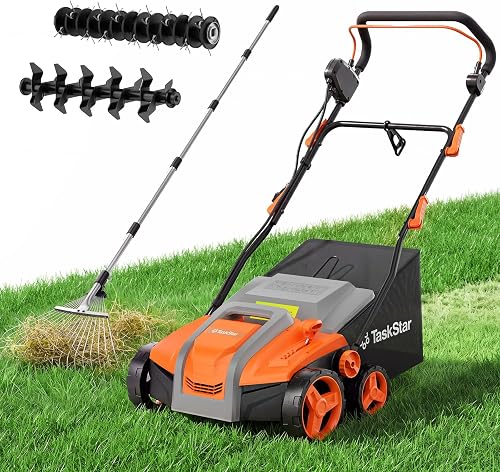
TaskStar Dethatcher and Scarifier: Best for spot touch-ups
- 15-amp motor, 16-inch path
- 5-position depth from -0.5 to 0.25 in
- Includes a thatch rake
- 14.5-gallon bag
- 28 lb
The widest corded path here plus a bonus thatch rake for corners and edges that the machine cannot reach.
Pros
- 16-inch path covers ground fast
- Bonus thatch rake for corners
- Foldable handle
Cons
- Heavier than the Greenworks and Sun Joe
- Bag fills fast on thick thatch
TaskStar suits the owner who dethatches big open stretches but still needs to clean tight spots. The 16-inch path is the widest corded option here, and the box includes an adjustable thatch rake for corners the motor can't reach.
A 15-amp motor reaches 3500 RPM, and built-in overload protection guards it on tough patches. Five depth positions run from -1/2 to +1/4 in.
TaskStar notes you should mow so grass stands about 1.97 inches tall before a run.
The 14.5-gallon bag is handy for patio edges and smaller areas, but TaskStar suggests taking it off for larger work. Weighing 28 lb, it folds flat for storage, and the 5-inch wheels roll across rough ground.
A cord clip keeps the extension cord clear of the tines. The handlebar has three height positions, so taller users can push without stooping.
On long, wide lawns the 16-inch cut pays back quickly, and the included rake handles the edges a walk-behind cannot reach. Its heavier frame is the trade against the lighter Sun Joe.
BILT HARD 16 Inch Dethatcher Scarifier Electric: Best for deep scarifying
- 15-amp copper motor, 16-inch path
- 20 spring steel tines
- 16 scarifying blades
- 5-position depth from -0.47 to 0.24 in
- 14.5-gallon bag
Two rollers, 20 tines and 16 blades, give a choice between gentle raking and deeper soil scoring for a tired lawn.
Pros
- Separate blade and tine rollers
- 5 depth settings
- Flat-free wheels
Cons
- Heaviest machine here at 57.3 lb
- Cord needed near the work
BILT HARD suits a tired lawn that needs more than a light rake. Its 20 spring steel tines and 16 scarifying blades are on separate rollers, so you get a gentle surface clean or a deeper soil score.
A 15-amp copper motor spins up to 3300 RPM across a 16-inch path. Five depth settings cover -0.47 to 0.24 in, and 7-inch front plus 6-inch rear flat-free wheels roll over uneven ground.
A lock-off switch and overload protection guard the motor during long runs.
That depth range and blade count are aimed at renovation, not just annual raking. The 16-blade roller scores the soil surface to open it up, while the 20-tine roller lifts dead material for the bag to catch.
A 14.5-gallon removable bag holds what the tines pull up. The trade is weight: at 57.3 lb it is the heaviest machine in this group, so it is a garage job rather than a quick carry.
BILT HARD also advises mowing before you run it, and the handle folds for storage.
Agri-Fab 45-0294 40-Inch Tow Dethatcher: Best tow-behind for mid-size acreage
- 40-inch working width
- 20 spring steel tines
- 7 x 1 3/8 in semi-pneumatic tires
- Pull-behind lever
- 3-year limited warranty
A 40-inch swath behind a lawn tractor clears a big yard in fewer passes than any walk-behind here.
Pros
- 40-inch path behind a tractor
- Replaceable heat-treated tines
- 3-year limited warranty
Cons
- Needs a towing tractor or riding mower
- No motor, so depth is set by tine weight
Agri-Fab suits the owner of a riding mower or garden tractor who wants to clear a big yard without walking it. The 40-inch swath and 20 spring steel tines cover an acre in far fewer passes than any walk-behind needs.
You attach it to a drawbar and lower the tines with an upright lever you can reach from the seat. The 7-inch semi-pneumatic tires travel most terrain, and the tines are heat-treated and replaceable.
The 3/16-inch spring tines are built to flex over roots and stones without snapping.
Agri-Fab covers it with a 3-year limited warranty. Its trade against the walk-behinds is reach: without a working lawn tractor it can't run.
On the largest lawns, though, a 40-inch pass beats any corded machine for speed. Some assembly is required, and a video guide is available.
There is no ballast tray here, so the tines rely on their own weight and how far you lower the lever.
Agri-Fab 48-Inch Tow Dethatcher: Best for the biggest mowed areas
- 48-inch working width
- 24 spring steel tines
- Universal hitch
- 7-inch flat-free wheels
- 70 lb weight tray
- 3-year limited warranty
The widest tow model here clears an acre or two with far fewer passes, and the weight tray helps tines bite in.
Pros
- 48-inch width for open yards
- 24 replaceable tines
- Weight tray for deeper bite
Cons
- Widest machine to store
- Needs a tractor with a compatible hitch
Agri-Fab's 48-inch unit suits the biggest mowed areas, where fewer passes save hours. Its 24 spring steel tines across a 48-inch path are the widest tow coverage here, and a 70 lb weight tray helps the tines press into matted thatch.
A cantilever transport handle raises and lowers the tines from your seat, and 7-inch flat-free wheels roll across varying ground. The universal hitch fits most lawn and garden tractors.
The tines are rust-proof, heat-treated and replaceable.
Agri-Fab builds it in Sullivan, Illinois and backs it with a 3-year limited warranty. Against the 40-inch model it gives more width at a heavier build, so storage and turning room matter.
The weight tray is optional ballast: fill it only when a first pass leaves thatch behind. If you have the tractor and open ground, this is the fastest option here.
The 24-tine count also spreads the load across more points than the 20-tine tow units.
BlumeTrec Tow Behind Dethatcher: Best for towing with an ATV
- 40-inch working width
- 20 heat-treated spring tines
- Universal pin-style hitch
- 100 lb ballast tray
- Bearing wheels
A pin-style hitch and 100 lb ballast tray make it an easy fit for ATV, UTV or rider owners who want a wide pull.
Pros
- Fits mowers, tractors, ATVs and UTVs
- 100 lb ballast tray
- Bearing wheels roll easily
Cons
- Avoid reversing while operating
- Requires a towing vehicle
BlumeTrec suits someone who tows with an ATV or UTV rather than a lawn tractor. Its universal pin-style hitch fits riding mowers, tractors, ATVs and UTVs, so you can use the vehicle you already own.
The 40-inch width and 20 heat-treated spring tines lift thatch and loosened soil. A 100 lb ballast tray adds bite where grass is thick, and bearing wheels give it a higher load rating.
The carbon steel frame is built to hold up over seasons.
Assembly comes with detailed instructions and a video, and BlumeTrec asks you to avoid reversing while it's operating. Compared with the Agri-Fab 40-inch, you gain the ATV fit and a bigger weight tray.
The two rows of independently flexing tines let each one ride over bumps rather than dig in. Clean the working parts after each use.
AugFir 48-Inch Tow Dethatcher: Best budget wide tow
- 48-inch working width
- 20 spring steel tines
- 150 lb weight tray
- Adjustable hitch
- 8-inch semi-pneumatic wheels
A wide 48-inch dethatcher with a big ballast tray and an adjustable hitch for a low-cost tow option.
Pros
- 48-inch width at a lower price tier
- 150 lb ballast tray
- Adjustable hitch height
Cons
- Fewer tines than the wider Agri-Fab
- Needs a socket wrench for setup
AugFir suits a large-yard owner who wants tow width on a budget. The 48-inch working width and 20 independently flexing tines cut the number of passes, and a 150 lb ballast tray is the biggest capacity here.
An adjustable hitch moves up or down in seconds to match your mower or trailer height, and it fits ATVs, UTVs, tractors and mowers. An anti-slip stopper slot keeps the handle from shifting on turns, and 8-inch semi-pneumatic wheels handle rough ground.
The handle has two height settings for lifting or lowering the tines.
The trade is tine count: 20 across 48 inches, where the Agri-Fab 48-inch fits 24. That makes it a lighter-duty tool for the same width.
Setup goes faster with a socket wrench or power tool, which AugFir does not include. The 150 lb tray is the deepest-ballast option, useful on hard, compacted ground.
How the best lawn dethatcher for large lawns was compared
We compared these machines on the specs that shape a large-lawn job: working width, motor or tow type, depth settings, tine count and weight. Width mattered most because it sets how many passes a big yard takes.
Our score weighs specs, features and buyer feedback against what you're shopping for. A wide path, adjustable depth and manageable weight carried the top spots.
Tow models gained points for coverage and lost some for needing a tractor.
We listed the highest score first, so the Greenworks leads and the AugFir closes the group. Each pick earns its badge from one real strength on a large lawn.
Walk-behind versus tow scoring
The walk-behind group scored on path width, depth range and carry weight. The tow group scored on working width, tine count, hitch fit and ballast capacity.
A 48-inch tow unit with 20 tines lost points to one with 24, because more tines share the load per pass.
How wide should a dethatcher be for a big lawn?
Aim for 40 to 48 inches if you tow, and 14 to 16 inches if you walk behind. Width is the single biggest time saver on a large yard, because every extra inch cuts the number of passes.
Walk-behind widths
A 12.6-inch path like the Sun Joe means more trips across a 10,000 sq ft lawn. The 14-inch Greenworks and 16-inch TaskStar or BILT HARD cut that count down.
Past about half an acre, though, no walk-behind matches a tow unit.
Tow-behind widths
A 40-inch tow dethatcher covers a strip of about 3.3 feet per pass. Step up to 48 inches and you clear about 4 feet per pass, roughly 6.7 extra square feet per 10 feet of travel.
On an acre that gap turns into a real difference in an afternoon's work. The Agri-Fab 48-inch pairs its width with 24 tines, while the AugFir spreads 20 across the same cut.
Matching width to your lot size
TaskStar's own guide puts working time at 20 to 30 minutes for 500 to 1,000 sq ft and 1 to 1.5 hours for 2,000 to 5,000 sq ft. Scale that up and 10,000 to 20,000 sq ft runs 3 to 5 hours on a walk-behind.
A tow unit covers the same ground while you ride the mower you were going to run anyway. TaskStar rates its machine for lawns up to half an acre, which fits the walk-behind side of that math.
Is a tow-behind dethatcher worth it for a large lawn?
Yes, if you already own a riding mower or tractor. A tow unit turns dethatching into part of a mowing session rather than a separate walk.
Without a tow vehicle, it stays in the shed.
A pull behind lawn dethatcher needs a drawbar or hitch, open ground for turns and space to store a 40 to 48-inch deck. In return, the tines work while you ride.
The Agri-Fab models add a transport lever you can reach from the seat. The BlumeTrec and AugFir widen the fit to ATVs and UTVs, and both accept a ballast load in their trays.
The AugFir's adjustable hitch also lets you match a trailer or UTV bar height without swapping parts.
If you have no tractor but still want width, the 16-inch electric models are the practical middle ground. They still need a cord and a walk, so plan a full afternoon.
A corded unit also starts with a push button and needs no gas, oil or tune-ups, which matters if the tow vehicle is out of service for the season.
Which depth setting should you use on a thick lawn?
Start shallow and go deeper on a second pass. Set the tines just deep enough to pull thatch to the surface, then raise the depth only if the layer stays thick.
The Greenworks gives three positions, the Sun Joe and TaskStar give five, and the BILT HARD five from -0.47 to 0.24 in. A lighter first pass protects grass crowns from being torn up.
More positions mean you can split the difference between a light rake and a deep cut instead of jumping straight to the aggressive end.
Tow models set depth by tine weight and the transport handle instead of numbered notches. Adding ballast, up to 70 lb on the Agri-Fab 48-inch or 150 lb on the AugFir, presses deeper.
Remove weight for the first run. The TaskStar note to mow to about 1.97 inches first applies to every machine here: tall grass clogs the tines and hides how deep you are cutting.
Corded electric or tow dethatcher for acreage?
A corded electric model suits lawns under about half an acre, and a tow model suits an acre or more. The dividing line is your mower, your cord reach and how much time you want to spend walking.
An electric dethatcher needs an outdoor cord rated for the motor's amps. A 15-amp TaskStar wants 14 AWG up to 25 ft and up to 50 ft, and 12 AWG from 50 to 100 ft.
A thin cord can trip the motor. TaskStar calls the wrong cord the top cause of motor failure.
A 13-amp Greenworks or 12-amp Sun Joe draws a little less, but the same rule holds: size the cord to the run.
Tow models have no cord but need fuel, space and a driver. On a very large lot the time saved is clear.
For a mid-size lawn, a wide corded model finishes in a few hours. The electric pick also starts with a push button and needs no gas, oil or tune-ups.
The BILT HARD adds overload protection so a tough patch trips the motor rather than burning it out.
What else makes a dethatcher easier on a big lawn?
Weight, bag capacity and start ease matter once the yard is large. A bagged machine like the Sun Joe or TaskStar saves a raking pass but needs frequent emptying on thick thatch.
The 8-gallon Sun Joe bag fills sooner than the 14.5-gallon bags on the TaskStar and BILT HARD.
Lighter machines are easier to push for long stretches. The Sun Joe at 21 lb and Greenworks at 28.7 lb suit repeated passes; the BILT HARD at 57.3 lb is better for one deep run.
Push-button starts on the corded models remove pull cords. Foldable handles on the TaskStar and BILT HARD shrink storage.
Flat-free wheels on the BILT HARD and the Agri-Fab 48-inch never go flat mid-job. Bearing wheels on the BlumeTrec roll easier behind a light ATV.
For raking by hand afterward, our guide to using a dethatching rake walks through the cleanup.
Best lawn dethatcher for large lawns: the verdict
For most large yards, the Greenworks 13 Amp is the best lawn dethatcher for large lawns because its 14-inch path and tool-free switch between dethatching and scarifying handle a full seasonal job. Choose the TaskStar if you want the widest corded path and a bonus rake, or the BILT HARD for deep renovation.
If you mow with a rider, go tow-behind. The Agri-Fab 48-inch is the fastest option for open ground, and the BlumeTrec is the fit for an ATV or UTV owner.
For smaller lots, check our picks for a cordless dethatcher instead.
Our top 3 picks at a glance
-
1
-
2
Best for catching thatch as you go
Sun Joe Corded Electric Lawn Dethatcher
9.4/10 our score
See it on Amazon -
3
Frequently asked questions
Should I use a tow-behind or electric dethatcher on a big lawn?
Pick a tow-behind model when you already own a riding mower or tractor, because a 40 or 48-inch swath clears bigger areas in fewer passes. Stick with a corded electric model for yards under about half an acre where you can run a long outdoor cord.
How wide a dethatcher do I need?
Match width to your mowing time. A 12 to 14-inch walk-behind suits small and mid-size yards, while a 40-inch tow unit saves real time past about half an acre.
A 48-inch tow dethatcher is the fastest choice for acreage.
Do I need to dethatch a large lawn every year?
Dethatch when the thatch layer is thick enough to block air, water and nutrients, not on a fixed yearly schedule. Cool-season grasses are best dethatched in early spring or early fall.
Warm-season lawns usually do better in late spring through early summer.
What extension cord does an electric dethatcher need?
Use a thick outdoor cord rated for the motor's amps. A 15-amp model like the TaskStar needs 14 AWG up to 50 ft and 12 AWG from 50 to 100 ft.
A thin cord can trip the motor or damage it.
Can a tow-behind dethatcher hurt my lawn?
It can if you set the tines too deep or add too much ballast. Raise the handle or remove weight for a first pass, then go deeper on a second run if thatch remains.
Water lightly the day before to soften the soil.


