9 Best Electric and Cordless Lawn Scarifiers (November 2026)
The best electric and cordless lawn scarifiers include the Greenworks 13 Amp 14-Inch Corded Dethatcher / for most home lawns, the WEN DT1516 16-Inch Electric Dethatcher for collecting the thatch, and the TIECTOWN 2026 Upgrade 16-Inch 15.5A Electric Dethatcher for large yards and long runs.
On this page (7 sections)
- The best electric and cordless lawn scarifiers for different yards
- How these scarifiers compare
- How we compared these machines
- What should you check before buying a lawn scarifier?
- When should you scarify your lawn?
- How do you use a scarifier without damaging the lawn?
- Which lawn scarifier is right for your yard?
The best electric scarifier for most home lawns is the Greenworks 13 Amp 14-Inch Corded Dethatcher / Scarifier, which gives you the petrol-machine action without fuel or engine upkeep. Its three depth settings and quick-release reels handle both thatch and moss.
True petrol lawn scarifiers are rare and heavy to run. The machines below deliver the same job, lifting dead thatch and cutting moss so air and water reach the roots, and each one is the right call for a different yard.
If you want to skip the cord entirely, our cordless dethatcher roundup covers battery options in more depth. For a smaller budget, see the budget lawn scarifier picks.
Our picks at a glance
-
1
 Best for most home lawns
Greenworks 13 Amp 14-Inch Corded Dethatcher /
9.6/10 our score
See it on Amazon -
2
 Best for collecting the thatch
WEN DT1516 16-Inch Electric Dethatcher
9.1/10 our score
See it on Amazon -
3
 Best for large yards and long runs
TIECTOWN 2026 Upgrade 16-Inch 15.5A Electric Dethatcher
8.9/10 our score
See it on Amazon
- 4
 Check it
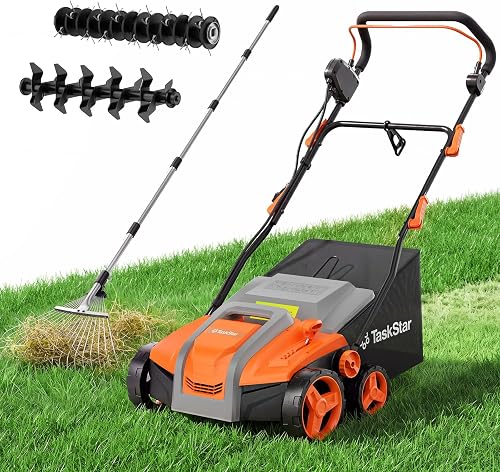
TaskStar Dethatcher and Scarifier
Best for tight corners and edges - 5
 Check it
BILT HARD 16 Inch Dethatcher Scarifier Electric
Best for heavy-duty build - 6
 Check it
Sun Joe 24V-X2-DTS15 Cordless Dethatcher
Best for cord-free convenience - 7
 Check it
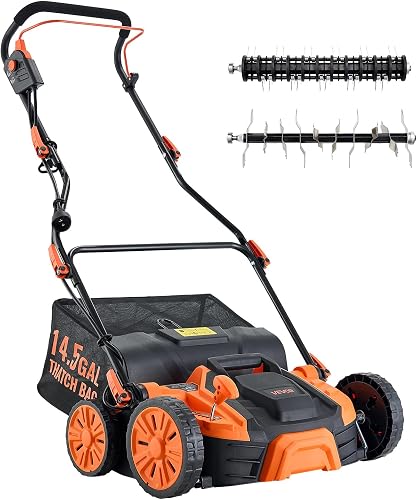
VEVOR 2-in-1 Electric Dethatcher and Scarifier
Best for quick storage - 8
 Check it
vidaXL Scarifier for Ride-on Mower 39.4
Best for large lawns behind a tractor - 9
 Check it
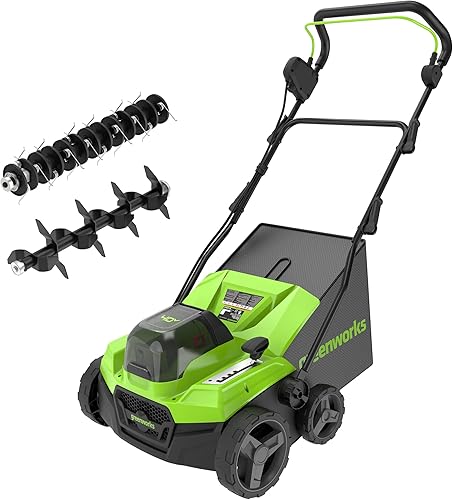
Greenworks 40V 15-Inch Cordless Dethatcher
Best for Greenworks 40V owners
The best electric and cordless lawn scarifiers for different yards
The Greenworks 13 Amp 14-Inch is the strongest all-round choice for a typical home lawn. The rest of the group wins on a specific need, from a wider path to towing behind a tractor.
Greenworks 13 Amp 14-Inch Corded Dethatcher /: Best for most home lawns
- 13-amp corded motor
- 14-inch working path
- 3-position depth adjustment
- Quick-release dethatcher and scarifier reels
A light corded machine that switches between dethatching and scarifying without tools. Three depth settings cover routine thatch pickup and deeper moss removal.
Pros
- Light enough to steer around beds
- Quick-release reel change
- Three depth settings
Cons
- Narrower path than the 16-inch models here
- Needs a cord and outdoor outlet
Greenworks suits a homeowner with a normal suburban lawn and an outdoor outlet near the grass. The 14-inch path and light body make it easy to steer around beds and trees.
Its three-position tine depth covers routine dethatching and deeper moss removal without changing machines. The quick-release switch lets you move from the dethatcher to the scarifier reel by hand.
Greenworks says to dethatch in early spring or early fall for cool-season grass, and in late spring through early summer after the second mowing for warm-season grass. The 13-amp motor spins the tines at 3200 RPM, which is enough to strip a matted layer without stalling in light growth.
Stainless steel tines stand up to repeated passes season after season. At 28.7 lb it is light enough to lift in and out of a shed or carry up a step.
The trade-off against the 16-inch machines here is a narrower path and no collection bag. For a small to medium lawn, that means less weight to push and easier storage.
Buy it if you want the simplest one-machine answer for a standard yard. Skip it for very large lawns where the wider 16-inch models finish faster.
WEN DT1516 16-Inch Electric Dethatcher: Best for collecting the thatch
- 15-amp motor at 3300 RPM
- 16-inch clearing path
- Detachable thatch collection bag
- 20-blade scarifying head and 24-tine dethatching head
A 16-inch corded machine with a bag that catches loosened thatch as you go. Five depth settings and a 20-blade scarifier make it a strong all-rounder.
Pros
- Wide 16-inch path
- Collection bag reduces raking
- Five depth settings
Cons
- Heavier than the Greenworks 14-inch
- Bag fills quickly on thick thatch
WEN suits a buyer who would rather not rake up thatch by hand after every pass. Its detachable collection bag catches the loosened material as the machine moves.
The 15-amp motor runs up to 3300 RPM across a 16-inch clearing path, and five depth settings range from +1/4 to -1/2 inch. That spread lets you set a light rake for thin thatch or drop lower to pull out a heavier layer.
A 24-tine dethatching head and a 20-blade scarifying head cover both jobs.
WEN adds an automatic overload shutdown that stops the motor when the tines hit rock or concrete. A two-year warranty backs the unit.
The bag detaches when you want to run bagless on thick growth.
The bag fills fast on thick thatch, so empty it often or run without it and rake afterward. Against the Greenworks, you gain width and collection but carry a heavier 33.7 lb machine.
Buy it for a mid-size lawn where catching the thatch matters. Skip it if you want the lightest steering or have a very small yard.
TIECTOWN 2026 Upgrade 16-Inch 15.5A Electric Dethatcher: Best for large yards and long runs
- 15.5-amp peak motor at 3600 RPM
- 16-inch rake path
- 14.5-gallon removable bag
- 5-position depth adjustment
The strongest motor in this group, paired with a large bag and a wide path. Suits bigger lawns where you want fewer passes and less emptying.
Pros
- Highest motor rating here
- Large 14.5-gallon bag
- Tool-free blade change
Cons
- Needs a heavy extension cord
- Cord management adds work on big lawns
TIECTOWN suits larger lawns and long working runs. Its 15.5-amp peak motor at 3600 RPM is the strongest here, paired with a 16-inch path and a 14.5-gallon bag.
Five depth settings split the work: scarifying runs from -0.47 to 0.24 inch and dethatching from -0.32 to 0.39 inch. That separate range for each mode is more precise than a single shared scale.
A tool-free blade change means you switch modes without hunting for a wrench.
The 14.5-gallon removable bag means fewer trips to empty it. A waterproof plug, cord clip and extension cord holder keep the cable tidy as you work.
A three-position adjustable rod fits users of different heights, so a taller or shorter operator can set a comfortable push.
TIECTOWN says the motor needs a heavy outdoor cord: 14 AWG up to 50 ft and 12 AWG up to 100 ft. That cord is the main chore compared with a battery model.
Buy it for a big lawn where motor power and bag size save passes. Skip it for a tiny yard where a light 14-inch machine is easier to handle.
TaskStar Dethatcher and Scarifier: Best for tight corners and edges
- 15-amp motor at 3500 RPM
- 16-inch path
- Bonus adjustable thatch rake
- 14.5-gallon collection bag
A corded scarifier that ships with a separate hand rake for spots the machine cannot reach. The main unit covers wide runs while the rake cleans edges.
Pros
- Includes a hand rake for edges
- Folds flat for storage
- Built-in overload protection
Cons
- Hand rake is extra work after machine passes
- Bag is best removed for large areas
TaskStar suits a yard with awkward edges, narrow strips and beds that the machine cannot reach. It ships with a separate adjustable thatch rake for spot work after the main passes.
The corded unit uses a 15-amp motor at 3500 RPM across a 16-inch path. Five depth settings run from -1/2 to +1/4 inch, and the 14.5-gallon bag is removable for larger areas.
Built-in overload protection guards the motor when the tines meet a hard object.
The bonus rake extends from 55 to 83.5 inches and widens from 7.9 to 17.3 inches. That makes it handy for tidying along fences and around shrubs.
At 28 lb with a foldable handlebar, it stores flat and lifts easily.
TaskStar notes the grass should be at about 1.97 inches before you start, so mow taller turf first. Against the WEN and TIECTOWN, the hand rake adds a cleanup step but covers the spots they miss.
Buy it if your lawn has edges and corners the machine skips. Skip it if you only need wide open runs and would rather not handle a separate rake.
BILT HARD 16 Inch Dethatcher Scarifier Electric: Best for heavy-duty build
- 15-amp copper motor at 3300 RPM
- 16-inch path
- 16-blade scarifier and 20-tine dethatcher
- 14.5-gallon removable bag
A heavier steel-bodied machine for buyers who want a solid feel. The 16-blade scarifier and 20-tine dethatcher cover both jobs with a bag to match.
Pros
- Copper motor
- Large flat-free wheels
- Five depth settings
Cons
- Heaviest corded model here at 57.3 lb
- Needs more storage room
BILT HARD suits a buyer who prefers a solid, heavy machine over a light one. Its steel body and flat-free wheels give it a planted feel on uneven ground.
The 15-amp copper motor at 3300 RPM drives a 16-blade scarifier and a 20-tine dethatcher across a 16-inch path. A 14.5-gallon removable bag holds the loosened thatch.
The scarifier aerates while the dethatcher picks up maximum thatch, so the two rollers do different jobs rather than the same one twice.
Seven-inch front and six-inch rear wheels roll over rougher turf. A tool-free quick-lock knob and a foldable handle make setup and storage simpler.
The lock-off switch adds a safety step before the motor starts.
The catch is weight: at 57.3 lb, this is the heaviest corded model here. It needs more storage room and more effort to lift onto a shelf.
Buy it for a yard with bumps and dips where stability matters. Skip it if you store the machine overhead or want the lightest push.
Sun Joe 24V-X2-DTS15 Cordless Dethatcher: Best for cord-free convenience
- Dual 24V batteries for 48V
- 600W brushless motor
- 14-inch width
- 10.6-gallon collection bag
A battery scarifier that avoids cords and fuel. The dual 24V packs and brushless motor suit medium lawns where runtime is enough for one pass.
Pros
- No cord or fuel
- 5-position depth control
- Includes two batteries and a charger
Cons
- Narrower path and smaller bag than the corded 16-inch models
- Runtime limits bigger jobs
Sun Joe suits a buyer who wants no cord trailing across the lawn. Dual 24V batteries give it 48V of runtime, and a 600W brushless motor turns the tines.
Its 24-tine dethatching cylinder and 7-blade scarifying cylinder cover both jobs. Five depth settings run from -0.375 to 0.4 inch, and a 10.6-gallon bag catches the debris.
The AirBoost cylinder is built to pull thatch rather than just loosen it.
The kit includes two 4.0-Ah batteries and a dual-port charger. That makes it a complete package out of the box, unlike tool-only cordless models.
A two-year warranty covers the tool.
Against the corded 16-inch machines, it gives up width and bag size. Runtime also limits how much lawn you finish on one charge.
Buy it for a medium lawn where cords are a hassle. Skip it for very large lawns where a corded machine runs all afternoon without a recharge.
VEVOR 2-in-1 Electric Dethatcher and Scarifier: Best for quick storage
- 15-amp motor at 3600 RPM
- 16-inch path
- 10-blade scarifier and 22-tooth rake
- 14.5-gallon detachable bag
A compact corded unit that folds down for small sheds. The snap-on blade system and wide bag make it easy to live with in tight storage.
Pros
- Light at 26.7 lb
- Folds for compact storage
- Tool-free blade change
Cons
- Scores below the stronger 16-inch models
- Corded only
VEVOR suits a buyer with limited shed space. The foldable handle reduces its stored height, and at 26.7 lb it is easy to lift out.
Its 15-amp motor at 3600 RPM works a 16-inch path. A 10-blade scarifier loosens soil and a 22-tooth rake clears thatch, with a 14.5-gallon detachable nylon bag.
The metal body and heavy-duty wheels give it more heft than the low weight suggests.
Five depth settings split scarifying from -0.47 to -0.12 inch and dethatching from -0.24 to +0.39 inch. A snap-on blade system means no tools for a mode change.
A two-position handle fits different user heights.
VEVOR rates below the stronger 16-inch models here on motor detail and overall polish. It is corded only and needs a heavy outdoor extension cord.
Buy it when storage space is tight and the lawn is modest. Skip it if you want the top motor ratings or the best build in this group.
vidaXL Scarifier for Ride-on Mower 39.4: Best for large lawns behind a tractor
- Tow-behind design
- Galvanized steel springs
- Connects to a ride-on mower coupling
- 40.2 x 33.5 x 14.6 in
A pull-behind rake for owners of a ride-on mower or lawn tractor. It needs a coupling device and does its work through spring pressure.
Pros
- Covers a wide strip per pass
- No engine to maintain
- Can be weighted for dense moss
Cons
- Needs a ride-on mower with a coupling
- No powered tines
vidaXL suits an owner who already has a ride-on mower or lawn tractor with a coupling device. It attaches behind the tractor and does its work through galvanized steel springs.
This is the closest thing to a petrol-machine experience here: your tractor provides the power and the rake follows behind. A 33.5-inch strip is covered per pass.
The steel frame measures 40.2 x 33.5 x 14.6 inches and weighs 34.8 lb.
For dense moss, vidaXL says you can add weights (not included) so the springs press harder. That pressure is the only depth control, so you tune the job by how much you load onto the frame.
It is best for large open lawns where hand-guided work would take hours.
The trade-offs are clear. It needs a tractor with the right coupling and gives no powered tines or collection bag.
On a small lawn it is more machine than you need.
Buy it for a large lawn behind a ride-on mower. Skip it if you do not own a tractor or only have a small yard.
Greenworks 40V 15-Inch Cordless Dethatcher: Best for Greenworks 40V owners
- 40V battery platform
- 14-inch dethatching path
- 5-position depth adjustment
- Quick-swap dethatcher and scarifier reels
A tool-only cordless scarifier for buyers already on the Greenworks 40V platform. It shares batteries with trimmers and blowers.
Pros
- Shares Greenworks 40V batteries
- Quick-swap reels
- Five depth settings
Cons
- Battery and charger sold separately
- Lowest score in this group
Greenworks 40V suits a buyer already invested in the Greenworks 40V platform. The tool-only design shares batteries with trimmers, blowers and chainsaws.
Greenworks lists more than 75 tools that run on the same packs.
Its 14-inch dethatching path and five depth settings cover both dethatching and scarifying. Quick-swap tine reels let you change mode by hand.
At 26.5 lb it is among the lightest machines here.
Greenworks gives depth ranges from -1/2 to +1/5 inch for scarifying and -1/10 to +3/4 inch for dethatching. A 3-year limited warranty backs the tool.
The dethatching range is deep, so you can set it low for a heavy spring cleanup.
The catch is that no battery or charger is included. If you own no Greenworks 40V packs, the Sun Joe kit is the better cordless buy here.
Its lower score reflects the missing power source and narrower path.
Buy it if you already own Greenworks 40V batteries. Skip it if you are starting from scratch on a cordless platform.
How these scarifiers compare
Every machine here lifts thatch and cuts moss, but they split into three groups. Corded electric models give the most power and the widest paths.
Battery models trade a little width for no cord. A tow-behind rake hands the job to your ride-on mower.
| Product | Best for | Power | Working width | Depth settings | Our score |
|---|---|---|---|---|---|
| Greenworks 13 Amp 14-Inch Corded Dethatcher / | most home lawns | 13 A corded | 14 in | 3 positions | 9.6 |
| WEN DT1516 16-Inch Electric Dethatcher | collecting the thatch | 15 A corded | 16 in | 5 positions | 9.1 |
| TIECTOWN 2026 Upgrade 16-Inch 15.5A Electric Dethatcher | large yards and long runs | 15.5 A peak corded | 16 in | 5 positions | 8.9 |
| TaskStar Dethatcher and Scarifier | tight corners and edges | 15 A corded | 16 in | 5 positions | 8.8 |
| BILT HARD 16 Inch Dethatcher Scarifier Electric | heavy-duty build | 15 A corded | 16 in | 5 positions | 8.7 |
| Sun Joe 24V-X2-DTS15 Cordless Dethatcher | cord-free convenience | 48 V battery | 14 in | 5 positions | 8.6 |
| VEVOR 2-in-1 Electric Dethatcher and Scarifier | quick storage | 15 A corded | 16 in | 5 positions | 8.3 |
| vidaXL Scarifier for Ride-on Mower 39.4 | large lawns behind a tractor | Tow-behind, no motor | about 33.5 in | Spring pressure only | 8.0 |
| Greenworks 40V 15-Inch Cordless Dethatcher | Greenworks 40V owners | 40 V battery, tool only | 14 in | 5 positions | 7.9 |
The corded group shares similar motors, so width and weight matter most. A 14-inch machine is easier to steer but needs more passes than a 16-inch one.
The heavier steel-bodied machines roll better over bumps but take more storage room.
Within that corded group, the differences are in the details. Bag size ranges from 14.5 gallons down to none at all.
Depth positions run from three on the Greenworks to five on the rest. Blade counts vary too, with 10-blade scarifiers on the VEVOR and 20-blade heads on the WEN.
That count changes how aggressively the machine cuts into the surface.
The battery models remove the cord but limit runtime. If you mow with a battery platform already, a tool-only scarifier keeps your battery count down.
For a complete cordless kit, the Sun Joe package is the readiest option.
A tow-behind rake only makes sense with a tractor. On a large lawn it covers ground fast and needs no engine of its own.
On a small lawn, the setup time outweighs the gain.
How we compared these machines
We compared specs and features rather than running the machines. Our score weighs motor size, working width, depth settings, collection bag, weight and build against what a home buyer needs for thatch removal.
Machines with a bag scored higher when the bag was large and removable. We also weighed how many depth positions a unit offers, since a wider range helps you match the job to the season.
The split ranges on the TIECTOWN, BILT HARD and VEVOR count for more than a single shared scale, because you can set scarifying and dethatching differently. Weight and storage came into it for buyers who lift or shelve the machine.
We also looked at what came in the box. A kit with batteries and a charger, like the Sun Joe, scored above a tool-only unit that leaves you to buy power separately.
Cord requirements counted too, since a motor that needs a thick outdoor cord is a hidden cost. A hand rake in the box earned credit for edge coverage.
We grouped the results by the yard each one suits, not by brand. That is why a lower-scored model can still be the right buy for a large lawn behind a tractor.
What should you check before buying a lawn scarifier?
Start with the engine question. Most home buyers do not need a petrol engine: a corded or battery machine does the same thatch removal with less upkeep.
If you do own a tractor, a tow-behind rake may beat any hand-guided model for large lawns.
Corded or battery?
Corded models give more power and run all day without a recharge. They need an outdoor outlet and a heavy extension cord.
Battery models free you from the cord but limit runtime and, in some cases, sell without a battery. A tool-only unit only makes sense if you already own that brand's packs.
How wide a path do you need?
A 14-inch path suits small to medium lawns and is lighter to push. A 16-inch path covers more ground per pass and usually carries a bigger bag.
The tow-behind rake covers about 33.5 inches behind a tractor. Wider is faster on open ground, but a narrower machine turns more easily around beds.
How many depth settings matter?
Three positions handle routine work. Five positions give finer control, which helps when you switch between light dethatching and deep moss removal.
A wider range also lets you match depth to grass type and season. Machines with separate scarifying and dethatching scales give you more precision than one shared lever.
Do you want a collection bag?
A bag saves you raking up thatch afterward. It fills fast on thick thatch, so a large removable bag is easier to live with.
Some owners prefer to run bagless and rake after, which is faster on big areas. Bag sizes here run from 14.5 gallons down to 10.6 on the Sun Joe and none on the Greenworks corded model and the tow-behind rake.
What cord does a corded scarifier need?
A 15-amp motor draws a lot of current, so the extension cord matters. TIECTOWN calls for 14 AWG up to 50 ft and 12 AWG up to 100 ft.
TaskStar lists 14 AWG up to 25 ft, 14 AWG up to 50 ft with 12 AWG better, and 12 AWG as a must for 50 to 100 ft. A thin cord is the most common cause of motor failure on these machines.
When should you scarify your lawn?
Scarify when thatch builds up enough to block air and water, which is usually about once a year. The season depends on your grass type and where you live.
Cool-season grasses are best done in early spring or early fall. Warm-season grasses suit late spring through early summer, after the second mowing.
Greenworks and the other makers here follow that general timing.
Check the thatch layer first. A thin layer may only need dethatching, while thick moss needs the scarifier's cutting action.
Our guide to how often you should dethatch a lawn walks through the depth test.
Mow the lawn before you start so the machine runs at an even height. TaskStar suggests grass at about 1.97 inches, and BILT HARD and VEVOR both say to mow first.
Let the grass dry so the tines lift thatch instead of smearing soil. Then work in straight passes and overlap slightly.
How do you use a scarifier without damaging the lawn?
Set the depth shallow for the first pass and work down gradually. Cutting too deep on the first run can tear roots and leave bare patches.
If thatch remains after that first shallow pass, drop one setting and go again. Stop when you reach soil and the tines are no longer lifting much material.
Clean up the loosened thatch afterward. A bag catches most of it; a hand rake handles edges and tight spots.
Our guide on how to use a dethatching rake covers the manual cleanup step. On the tow-behind rake, keep the tractor at a steady slow speed so the springs comb the lawn rather than tearing at it.
Water the lawn after scarifying and keep off it for a few days so the grass recovers. Avoid scarifying in the heat of summer or when frost is expected.
Check for buried irrigation or electric lines before a deep pass, since the tines cut into the soil surface.
Which lawn scarifier is right for your yard?
The Greenworks 13 Amp 14-Inch is the best electric scarifier for most home lawns, with three depth settings and quick-release reels at a manageable weight. Pick the WEN DT1516 if you want a 16-inch path and a bag to catch the thatch.
For the rest of the group, match the machine to the yard. Choose TIECTOWN for the strongest motor and a large bag on a big lawn.
Take the Sun Joe if you want cord-free work and a complete kit. Buy the vidaXL rake only if you already run a ride-on mower on a large lawn.
If you are weighing up battery tools instead, the cordless dethatcher roundup covers more options. For a smaller spend, the budget lawn scarifier picks keep the cost down.
Whatever you choose, set a shallow depth first and work down. A patient first pass protects the lawn and gives you a healthier result than one aggressive run.
Our top 3 picks at a glance
-
1
Best for most home lawns
Greenworks 13 Amp 14-Inch Corded Dethatcher /
9.6/10 our score
See it on Amazon -
2
Best for collecting the thatch
WEN DT1516 16-Inch Electric Dethatcher
9.1/10 our score
See it on Amazon -
3
Best for large yards and long runs
TIECTOWN 2026 Upgrade 16-Inch 15.5A Electric Dethatcher
8.9/10 our score
See it on Amazon
Frequently asked questions
Do petrol lawn scarifiers exist for home lawns?
Yes, but true petrol-engine scarifiers are uncommon and heavier to maintain. Most home buyers choose corded electric machines or battery models that copy the same action.
A tow-behind rake behind a ride-on mower covers very large lawns without an engine of its own.
How often should I scarify a lawn?
Most lawns need scarifying once a year in early spring or early fall for cool-season grass. Warm-season grass is usually done in late spring to early summer after the second mowing.
Check thatch depth first; thin thatch may only need dethatching.
What is the difference between scarifying and dethatching?
Dethatching lifts dead surface thatch with spring tines. Scarifying cuts into the soil surface to loosen moss and compacted turf so air and water reach the roots.
Many machines here include both reels, so you switch depending on the job.
Can I scarify a wet lawn?
No. Avoid wet or muddy lawns; wait until the grass is dry to the touch so the tines lift thatch instead of smearing soil.
Mow the lawn first so the machine runs at an even height.
How wide should a scarifier be for my lawn?
A 14-inch model suits small to medium lawns and is lighter to steer. A 16-inch model covers more ground per pass and usually carries a bigger bag.
For lawns of half an acre or more, a tow-behind rake behind a ride-on mower saves the most time.


